
How the book came to be
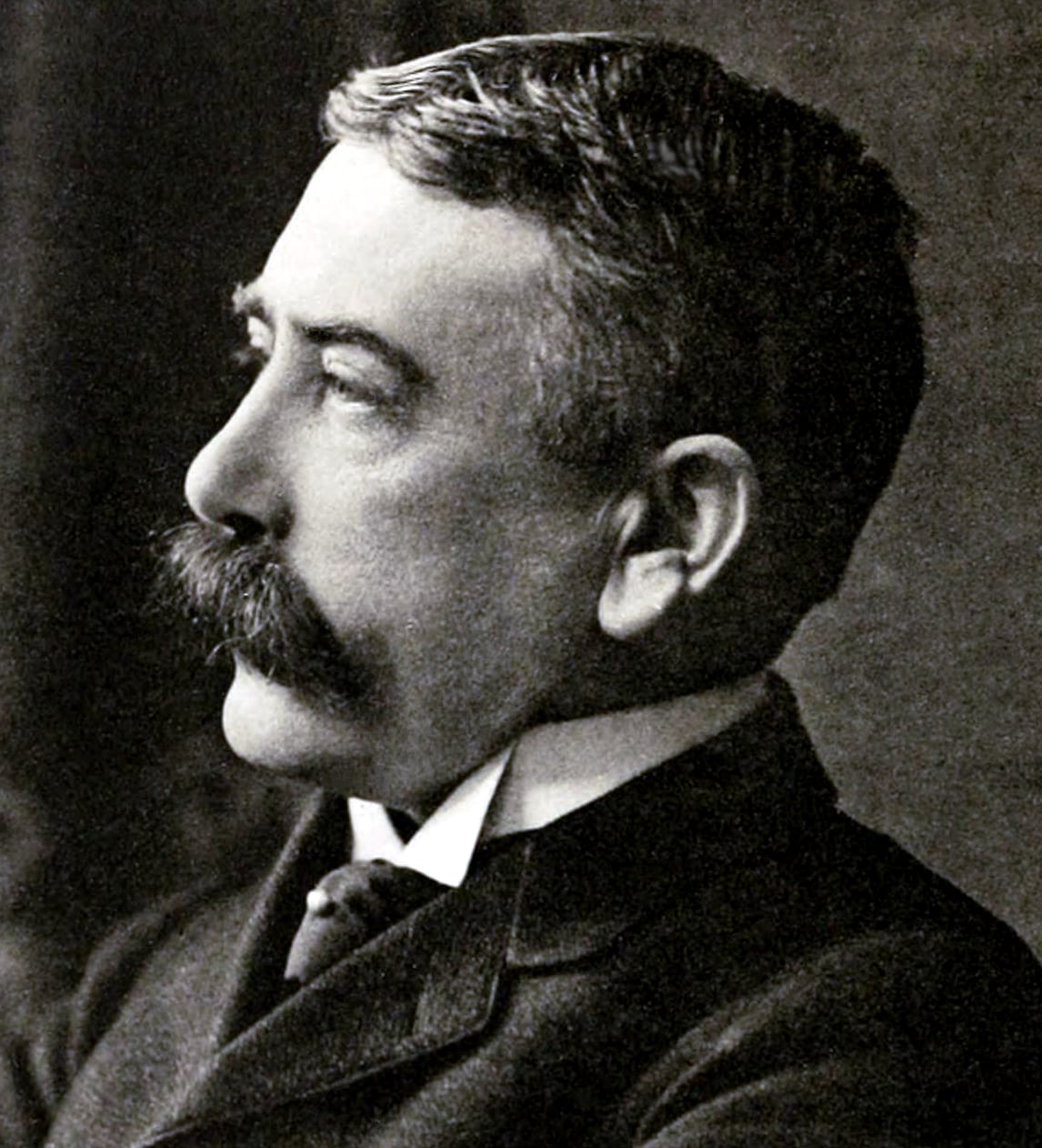
The Course in General Linguistics is not a book Saussure wrote. It was reconstructed by his students Charles Bally and Albert Sechehaye from notes taken by those who attended his three lecture series at the University of Geneva (1907–1911), and published in 1916, after his death. The text is therefore a reconstruction of his teaching rather than a manuscript in his own hand — a responsibility the editors state plainly in their preface.
1. The object of linguistics — langage / langue / parole
Human speech (langage) is a heterogeneous mass straddling the physical, physiological, psychological, individual and social; as such it cannot be the object of a science. Saussure draws three things apart.
- langue (the language system): a system of signs shared by a community. Social, essential, homogeneous; the individual can neither create nor modify it. It is a “storehouse” in each speaker’s brain —
1 + 1 + 1 + … = 1(every member holds roughly the same system). - parole (speaking): the individual, wilful, momentary act of using the system.
- The proper object of linguistics is langue. Parole belongs to a separate discipline (a “linguistics of speaking”).
2. Semiology
Langue is “a system of signs that express ideas,” and so belongs with writing, sign language, rites, military signals, and the like. Saussure envisages semiology, a general science of the life of signs in society, of which linguistics would be one branch. Because language is the most complex and universal system of signs, it can serve as the master pattern for semiology as a whole.
3. The nature of the linguistic sign
The sign is not a link between a thing and a name but a psychological unit joining signified (concept) and signifier (sound-image). Language is not a nomenclature — ready-made ideas do not exist before words.
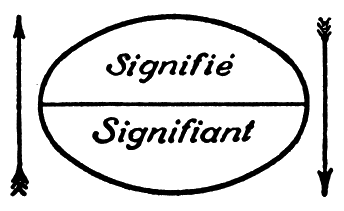
- Principle I: the arbitrariness of the sign. There is no natural bond between signified and signifier (nothing links the idea “sister” to the sound sequence s-ö-r). Onomatopoeia and interjections are marginal and do not refute this. Symbols differ, in that they are partly motivated.
- Principle II: the linear nature of the signifier. Being auditory, the signifier unfolds in time and forms a one-dimensional chain.
4. Immutability and mutability of the sign
Immutability: neither the individual nor the community can choose a sign anew. Language is always a heritage from the preceding period — a law that is tolerated, not consented to. Four reasons: (1) its arbitrariness leaves no ground for argument; (2) the number of signs is enormous; (3) the system is over-complex; (4) everyone uses it at all times, so collective inertia rules.
Mutability: over time signs do change, and every change ultimately shows up as a shift in the relation between signified and signifier (Latin necare “kill” → French noyer “drown”). Continuity is precisely what exposes the sign to change.
5. Synchrony and diachrony
Language is “a system of pure values determined by nothing except the momentary arrangement of its terms.” Research therefore splits along two axes.
- Synchronic (static): relations within one language-state. For the speaker time does not exist; there is only a state. A synchronic fact always involves two coexisting terms in opposition, and is meaningful.
- Diachronic (evolutionary): the passage from state to state. A diachronic fact is an isolated, fortuitous event; it does not aim at the system but alters single elements, with no intention behind it.
The chess analogy: a position on the board corresponds to a language-state; a piece’s value comes from its relations to the others; a single move (a diachronic change) is local but reverberates through the whole; each position is freed from its history. One point differs: the chess player intends the move, whereas language premeditates nothing — it is “an unconscious player.”
6. Linguistic value — “only differences”
Before language, neither ideas nor sounds are divided. Thought is a nebula; sound is a plastic mass. Langue carves units out between the two and produces form, not substance. Language is like a sheet of paper — thought the front, sound the back; you cannot cut one without cutting the other.
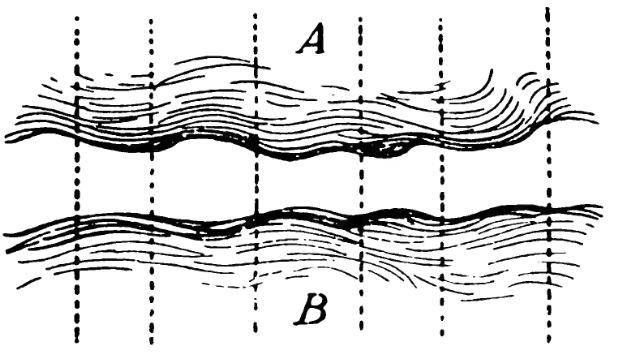
- Value is not the same as signification. Like a coin, a word’s value depends both on what it can be exchanged for (an idea) and on what it can be compared with (other words that stand against it). French mouton overlaps in meaning with English sheep but not in value (English also has mutton). Tense, number and aspect likewise carry different values in different languages and do not correspond.
- Concepts and sounds alike are purely differential — defined by “being what the others are not.” Phonemes too are “opposing, relative, negative entities.”
The famous formula: in language there are only differences without positive terms. Yet the sign taken as a whole (signifier + signified together) is a positive fact.
7. Syntagmatic and associative relations
- Syntagmatic relations: the bonds a term forms with what precedes and follows it in the chain. In praesentia. They apply to words, phrases and whole sentences.
- Associative relations: groups formed in memory, outside discourse, among words that share something (enseignement — enseigner / armement / éducation …). In absentia, with no fixed order or number.
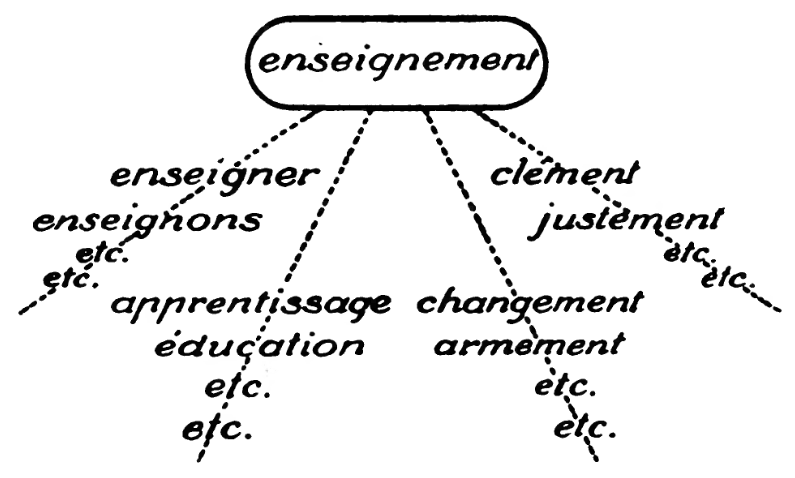
Saussure’s column: the column’s relation to the architrave it bears is syntagmatic; the mental comparison of a Doric column with the Ionic and Corinthian styles is associative. Every time a speaker speaks, both kinds of relation are used to select the needed oppositions from a latent system.
8. The mechanism of language — limiting arbitrariness
Some signs are radically arbitrary; others are relatively motivated. French vingt “twenty” is unmotivated, but dix-neuf “nineteen” recalls dix + neuf and is relatively motivated. Associative and syntagmatic solidarities partly restrict arbitrariness and bring order to the system. Languages that lean toward unmotivated signs are more “lexicological”; those with more motivation are more “grammatical.”
9. Diachronic linguistics
- Phonetic change is regular and blind; it works on sounds alone, independently of meaning and of the system.
- Analogy: honos → honor (orator : oratorem = honos(em) : x). This is creation, not change — the new form does not replace the old one, and the two coexist for a time (the loss of the old form is a separate event). Analogy is grammatical and synchronic; it presupposes that the speaker grasps a relation between forms, and it originates in parole.
- Folk etymology and agglutination are treated as related phenomena.
10. Geographical linguistics
The diversity of languages is caused not by space but by time (“geographical diversity should be called temporal diversity”). When one language is carried to a new place, change occurs independently on both sides.
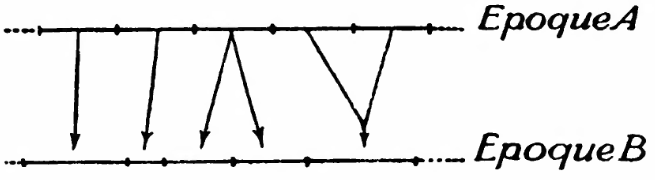
Two forces operate: provincialism (esprit de clocher) drives dialectal splitting, while intercourse spreads innovations and unifies. The geographical boundary of a dialectal fact spreads as a wave.
11. Retrospective linguistics
Diachrony has a prospective method (following documents forward) and a retrospective one (reconstructing an earlier form by comparison). The original form of a single isolated sign cannot be recovered, but comparing several signs of common origin lets one reconstruct a prototype (e.g. Proto-Indo-European) inductively. It is a historical science, like geology. Language does not coincide with race or ethnicity; treating a language as an organism with its own law of evolution, in Schleicher’s manner, is a mistake.
Conclusion
Carve langue out of the mass of speech facts, and describe it first synchronically, as an autonomous system of differences and oppositions. The sentence that closes the book: the true and unique object of linguistics is langue considered in and for itself.
This view of system and sign — arbitrariness, differential value, the primacy of synchrony, the langue/parole distinction — became the starting point for twentieth-century structuralism, semiotics, anthropology, literary theory and philosophy.


